
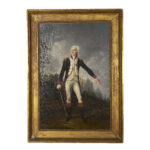
Joseph Boze and Ursule Boze
Portrait of the Marquis de La Fayette
Lieu de pub., Éditeur ou imprimeur, Date de publication
- Dimensions: 72 × 48 cm
Vendu
Description
Oil on canvas
Bibliography: Unpublished.
This unpublished portrait of the Marquis de Lafayette is an exceptional testimony to the popularity and fame of this illustrious figure of Franco-American history. Because of its multiple contributions, it is a notable addition to the work of Joseph and Ursule Boze but also to the iconography of the famous model. Through their touches, the two artists depict not only him but also the values of freedom, humanity and fraternity that he embodied.
An emblematic figure in Franco-American relations, Gilbert du Motier, Marquis de Lafayette, was one of the most important figures of the second half of the 18th century. He embarked for the United States in 1777 as a volunteer to support the American insurrection against the British. Enrolled in the army, the Marquis de Lafayette developed a strong relationship with General George Washington and actively participated in the independence of the Thirteen Colonies. He became known as the “hero of the two worlds” and became one of the eight honorary citizens of the United States. Upon his return to France, the Marquis was also a major player in the French Revolution. Emigrated and imprisoned in Austria, he finally returned to France in 1800 where he retired to his castle of La Grange-Bléneau in Courpalay.
Lafayette made a triumphant trip to the United States between 1824 and 1825, and also played an important role during the July Revolution in 1830. This illustrious character died on May 20, 1834, of acute pneumonia and was buried two days later. A great celebrity of his time, Lafayette is the subject of an important iconography, notably through engraving.
This unpublished work is an important rediscovery since it is a portrait of Lafayette by Joseph Boze and his daughter Ursule. Active from the Ancien Régime to the Restoration, Joseph Boze painted many illustrious characters including Louis XVI, Marie Antoinette, Robespierre and Marat. He is best known for having painted an effigy of the glorious “hero of the two worlds”, now preserved in Boston at the Massachusetts Historical Society.
In April 1790, Thomas Jefferson asked his secretary in Paris, William Short, to commission a portrait of Lafayette to complete his collection of paintings of famous men. Once completed, the portrait was to be installed in his dining room at Monticello. According to Gérard Fabre, William Short had some difficulty in finding an available painter, especially since he knew that the artist would have difficulty posing Lafayette, who was very busy with his duties as commander of the Paris National Guard.
In September 1790, Joseph Boze fulfilled this task, and the press echoed his latest creation, first in Le Moniteur universel (September 26, 1790), then in Affiches, annonces et avis divers (September 29, 1790):
“M. Boze, painter to the king, who in 1784 made the most resembling portrait of S.M. that had been made up to that point, has just executed the portrait of M. Lafayette with the same success. The staff of the national guard of Paris and a great number of confederates of the various departments of the kingdom seemed to wish that it was engraved as soon as possible by one of the best artists of the capital. It is to support their views that this work will be executed incessantly by an artist advantageously known by the delicacy and the soft touch of his burin. The price of this beautiful print will be only 6 livres, which will be deposited by subscribing at M. Rameau, notary, place des Victoires, n°7. It is necessary to register as soon as possible to accelerate the execution. The subscribers and other people will be able to see this portrait at any time of the day at M. Boze, painter of the king, place des Victoires.”
After being exhibited all autumn in the painter’s studio, the painting was finally crated, transported to Le Havre and shipped to the United States around December 23, 1790.
Our unpublished painting, showing Lafayette standing, was done after the Massachusetts Historical Society painting. The catalog of the exhibition dedicated to Joseph Boze specifies that in the early 1800s, “Boze, helped by his daughter Ursule, painted and drew soldiers, generals and other ambassadors of Paris”. Ursule Boze continued the family tradition and made her work known through engraving and drawing. She specialized in portraits of generals, including Étienne Macdonald and Jean-François Carteaux.
Another version of our portrait is currently in the Mount Vernon Memorial Highway. The Boze family was accustomed to producing several versions of its portraits according to customer requests. It is interesting to note that our work and that of Mount Vernon share the same characteristics in terms of subject, touch and dimensions, only the background differs.
The background of our painting is also used for the Portrait of General Berthier by Ursule Boze. The engraving of this painting by Pierre Charles Coqueret attests to this. This practice of reusing backgrounds was widely used at the time and it is also found for the two pairs of paintings Mirabeau and Marat, Madame de Serres and Comtesse de Provence.
In addition to La Fayette, Joseph Boze probably portrayed another great figure in American history, Benjamin Franklin. During this period, Joseph Boze lived in the rue Ventadour, near the rue des Moulins, where Benjamin Franklin frequently went during his stay in Paris to attend the salon held by the Baron d’Holbach.
Joseph Boze maintained a family of 12 people and the family was forced to move from the workshops of the Louvre to those of the Sorbonne. To be able to feed his family, Joseph Boze was very protective of his work and did not hesitate to resort to the legal system. He testified in particular against the artist Jacques-Louis David on March 10, 1795.
With this portrait of La Fayette, Joseph and Ursule Boze created a powerful image of one of the most emblematic figures of his time and of the strength of Franco-American ties. It is an exceptional testimony of the art of this period and of an illustrious character.
Bibliography
J.-A. Volcy-Boze, Le comte Joseph de Boze, peintre de Louis XVI, Marseille, Impr. de M. Olive, 1873, 93 p.
Etienne Charavay, Le Général La Fayette (1757-1834), Paris, la Société, 1898, 656 p.
André Foulon de Vaulx, Un pastelliste du XVIIIe siècle, Joseph Boze, 1745-1826, Paris, É. Paul, 1901, 52 p.
Le général La Fayette, Paris, Pershing Hall, mai 1934. Commissariat : Georges Coquard, Paris, Ducres et Colas, 1934, 200 p.
Louis Gottschalk, Lafayette between the American and the French Revolution, 1783-1789, Chicago, University of Chicago Press, 1950, 461 p.
La Fayette, Paris, Archives nationales, 4 juillet 1957 – 10 octobre 1957. Commissariat : Chantal de Tourtier, Monique Sarotte et Jean-Pierre Babelon, Paris, Archives nationales, 1957, 180 p.
Compagnons de Lafayette, Le Puy, baptistère Saint-Jean, 3 juillet 1976 – 15 septembre 1976. Commissariat : Yves Soulingeas et Frédérique Vialet, Le Puy, Cahiers de la Haute-Loire, 1976, 19 p.
La Fayette et son temps, Brioude, mairie de Brioude, 3 juillet 1976 – 6 septembre 1976. Commissariat : Josanne Pothier, Brioude, la Ville, 1977, 47 p.
Lloyd Kramer, Lafayette in two worlds: public cultures and personal identities in an age of revolutions, Chapel Hill, University of North Carolina Press, 1996, 354 p.
Joseph Boze, 1745-1826, portraitiste de l’Ancien régime à la Restauration, Martigues, musée Ziem, 18 novembre 2004 – 20 février 2005. Commissariat : Gérard Fabre, Paris, Somogy, 2004, 263 p.
Portraits publics, portraits privés, 1770-1830, Paris, galeries nationales du Grand Palais, 4 octobre 2006 – 9 janvier 2007; Londres, the Royal Academy of Arts, 3 février 2007 – 20 avril 2007; New York, the Solomon R. Guggenheim Museum, 18 mai 2007 – 10 septembre 2007. Commissariat : Sébastien Allard, Amar Arrada, Malcolm Baker, et al., Paris, RMN, 2006, 383 p.
Paul S. Spalding, Lafayette: prisoner of state, Columbia, University of South Carolina Press, 2010, 403 p.
Laurence Chatel de Brancion et Patrick Villiers, La Fayette: rêver la gloire, Saint-Rémy-en-l’Eau, Monelle Hayot, 2013, 343 p.
Bernard Vincent, Lafayette, Paris, Gallimard, 2014, 184 p.
Laura Auricchio, The marquis: Lafayette reconsidered, New York, Alfred A. Knopf, 2014, 409 p.
Jean-Pierre Bois, La Fayette: la liberté entre révolutions et modération, Paris, Perrin, 2015, 495 p.
La Fayette: la traversée d’une vie, Rochefort, musée Hèbre, 14 juin 2017 – 1er octobre 2017. Commissariat : Laurence Chatel de Brancion, Saint-Rémy-en-l’Eau, Monelle Hayot, 2017, 94 p.